Latest entries »

[This is part two in a series of posts on probability and roleplaying games.  You can begin with part 1 here.]

Who else remembers these?

RPG designers haven’t always looked at the role of probability in action-taking in the same way.  In fact, over time, those designers have made it more and more likely that players will succeed at their actions.

What’s the most common thing players do in RPGs?  They try to whack a baddie on the head.  So let’s start from there and see how likely, historically, you’ve been to successfully whack that baddie.  And let’s narrow it further and look at fantasy RPGs:  what happens when a fighter-type tries to smack a goblin with a sword?  How often does he hit?

If we jump in the Wayback Machine and head to the days of 1st Edition Advanced Dungeons and Dragons, said fighter’s chances ain’t looking so good.  A 1st-level human fighter with Strength 16 – average for a fighter using the recommended method for rolling character attributes – has only a 30% chance of hitting a lowly goblin with his sword.  That’s right:  just 30%.  Now, there were a lot of quirks to AD&D’s system are worth exploring in their own right, as they show other ways in which the genre has evolved; for example, all 1st-level characters had exactly the same chance to hit our poor goblin, but fighters were vastly more effective at higher levels, which is very different from how most modern games handle level progression.  Still, for now, we’ll just stick with our simple number.

In other words, back then, a character could be expected to fail at this core action over and over.  Fast forward to AD&D’s 3rd Edition, and the picture looks somewhat different.  Take the 1st-level human fighter again, still with Strength 16.  He’s got +4 to hit – +1 from having a level of fighter, +3 more from Strength – and he’s facing a goblin with an AC of 15.  This gives him exactly a 50% chance to hit.

Now look at the 1st-level human fighter of today.  He has a Strength of 18 if we use the standard score array and assign his +2 racial bonus to Strength.  This gives him +4 to hit from his strength, +3 more from using a long sword.  We presume he chose the one-handed combat style, for +1 more.  We assume no other bonuses from feats, and that he’s just using his basic attack, instead of a power like Sure Strike.  There’s not just a single goblin for him to face, but most goblins have an AC of 16.  Now he has a 65% chance to hit.

What we see in these numbers is a direct and dramatic climb in the chances of success over the years.  This change can’t have been accidental:  just take a look at the notes on variant rules in the 3rd Edition Dungeon Masters Guide to understand how sensitive the D&D game design team was to the impact of much more minor rules changes than than these.  The designers made a conscious decision to have players succeed more and more often at their actions.

Okay then:  why has the number changed so much over time?  I think there are four interrelated answers:

  1. Success is fun.  While letting players succeed with their characters’ actions all the time takes away the benefits of dice-rolling, players will nevertheless have more fun if they succeed more often than they fail.
  2. Inaction is boring.  Failure usually results in nothing happening; a miss in combat, or a failed skill check, is usually wasted time.
  3. Wasting limited resources feels frustrating.  If I can only cast a certain number of spells each combat, or can only use my special power twice per day, I’m going to save it up for when it matters; when the time comes, I want it to be likely to count for something.  (You can see 4th Edition D&D take this a step further by introducing a number of daily powers that are guaranteed to have at least some effect, albeit a reduced one, even if they fail.)
  4. Failing takes time.  Assuming that the rate of foe failure is similar to that of characters (not always true, but close enough), introducing more failures means that the time it takes to resolve a conflict in a game is directly lengthened by the chance of failure, without changing the eventual outcome.

Now, you can have too much of a good thing.  The previous post already explored a bit of why succeeding all the time isn’t necessarily good.  Consider also what happens if the time allotted to a conflict is compressed by a very high rate of success:  that leaves fewer opportunities for player decisions, fewer chances for tactics and dramatic roleplaying, fewer moments where a gamemaster or computer can spring a surprise on the players.

But the point is that the people in the know – the Dungeons & Dragons designers, reacting to ever increasing amounts of data – steadily hiked up the chance of success, because they saw reasons such changes would improve their game.

Now, another factor started to appear in the ’80s, and has proceeded to become ever more significant, which is the rise of computer RPGs – games which began as followers in the trends set by paper and pencil RPGs, but have since switched roles to become leaders.  More on the impact of CRPGs, and the evolution of Conclave’s own use of probability to decide the results of actions, in the next post.

A great roll... but why are we rolling in the first place?

One question a game designer must ask is how often players should be able to succeed at the actions they take.  In many games, success is automatic:  you can’t fail to use a capturing move in chess, say, or to buy a property in Monopoly.  In fact, the majority of non-electronic games are based off of automatic success.  This is not to say random elements – the roll of a die to determine movement, say, or the cards you draw from a shuffled deck – but most such games limit the actions you can take through randomness, rather than leaving up to chance whether or not you will be able to successfully take your actions.

RPGs are one major exception to this rule.  Another is wargaming, roleplaying’s ancestor: Dungeons & Dragons evolved out of Chainmail, which took the mechanics of wargaming and applied them to the swords and sorcery genre.  As part of its inheritance, Dungeons & Dragons relied heavily on dice to determine if player actions succeeded.  (In fact, early editions of Dungeons & Dragons offered options to use dice to handle almost anything you might want to do in the game, from creating dungeons to determining which of twenty forms of insanity a character might develop if rendered insane, to figuring out what might happen if you mixed a potion of invisibility with a philter of love.  More on this topic later in this series of posts.)

Later RPGs questioned the centrality of dice in the game, with many seeking to reduce randomness, and some eliminating it entirely in favor of some mix of gamemaster and player dictate.  Often this came from the desire for stronger storytelling:  both gamemasters and players rebelled at having a story shredded by a particularly ill-timed lucky (or unlucky) roll.  But most RPGs kept dice.  Why?

One reason is that dice can be exciting.  Randomness – uncertainty – creates tension and variety.  This is pretty obvious!

But a second reason is that randomness helps enhance the sense that the RPG is a simulation of reality.  RPGs inevitably seek, to varying degrees, to simulate some version of reality, some cosmos.  In the real world, we are used to the idea that our actions will not always succeed or have perfectly predictable results.  The abstraction of the die roll provides a simple path to creating the same situation for our characters and their foes.  It’s easier to imagine ourselves into the bodies of our characters when we can’t know if they will succeed or fail within the larger world.

Additionally, as simulations, RPGs must handle a huge variety of possible actions, situations, and outcomes.  The RPG must be able to provide appropriate results depending on whether your warrior is trying to hit a cowering kobold, a veteran swordsman, an ancient dragon, or a deity (!).  Probability is a great mechanism here, expanding success from a simple digital yes-no to an analog range.  Boardgames cover a vastly smaller set of situations; with a simple possibility space comes the possibility of using simpler tools for resolving actions.

So die rolling is good, right?  Hold on there, sparky!  If there’s one thing any game designer, in any genre, knows, it’s that too much randomness – too much of that uncertainty mentioned above – can spoil the game-playing aspect of a game.  Players want to have control, too; they want to feel that their skill has an effect on the outcome of the game.  RPGs are funny beasts in many ways, and one is the tension they experience between giving players the unpredictability and simulationism enabled by die-rolling, and the desire to exert control.  Mess up this equation, and your game will become less fun.

What’s more, dice rolling takes time.  Every die roll involves a wait, and potential distraction from the flow of the game as a player digs for dice, adds up the results, and the roll gets checked against various charts and sheets to produce an outcome.  Such is not a concern with computer games, but you can bet that card and board game designers worth their salt take this sort of thing into account.

Having looked at some theory behind randomness in RPGs, we can next look at how randomness has evolved in RPGs over time – and what it looks like for today’s CRPGs.  That will be the topic of the next post in this series.

It’s alive!

Conclave

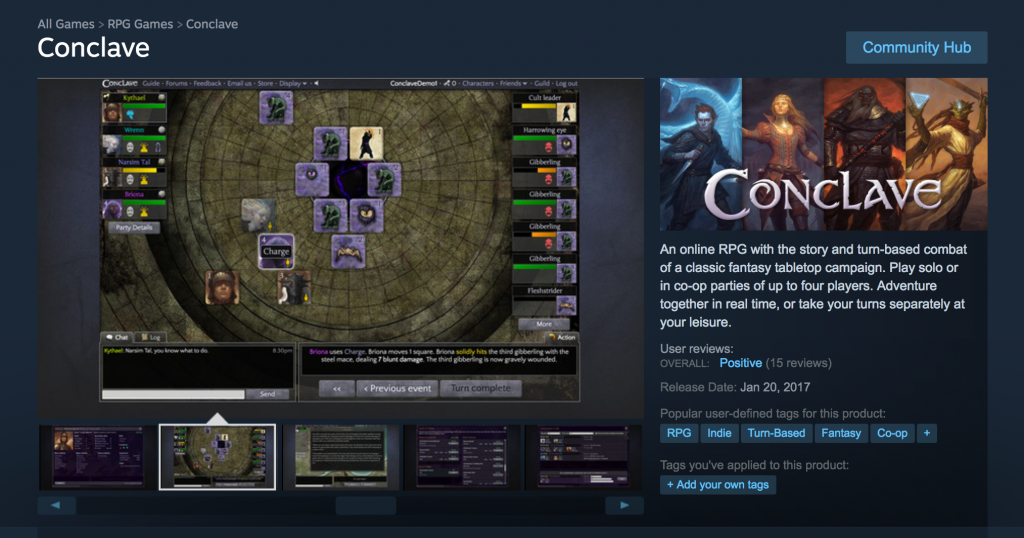
If you’re not following @10×10Room on Twitter, you might not have heard our big news: Conclave is open to the public!

We’ve put a ton of work into the game, and we’re thrilled to finally be able to show it off. We don’t think anyone else has made a game quite like it. A multiplayer RPG set in an original fantasy world that you can play from any web-enabled PC, tablet, or phone? And that you can play whenever you have a few minutes of free time, even if you and your friends have different schedules? Sounds kind of crazy even to us, really.

Since we’re a three-person team and this is still a beta release, expect a few rough edges here and there. We’re opening up the game now because we’d like you to help shape it from here on out, and we need your feedback for that.

But enough talk. Go play, and tell us what you think!

You wouldn’t know it from how little we’ve posted lately, but we’ve been very busy working on our game the past few months.

Conclave

Same game, new name

The most obvious change, if not the most significant, is that it has a new name: Conclave. For the first year and a half of development its working name was Bastion, but you might have heard about the recent launch of another game by that name. Although we were using the name first, we didn’t think a legal battle would be in anyone’s interest, and it gave us a chance to come up with something better. The word “conclave” refers to an assembly or gathering, and we think that’s fitting for a game designed to bring friends together online. It also has an important in-game meaning, which you’ll hear more about in the future.

Besides the name change, our summer can be summed up in three words: development, development, development. We received a hugely positive response when we demoed the game at the “Made in MA” event on the eve of this year’s PAX East, and since then we’ve been working to complete everything that wasn’t ready then. To make sure we’re staying on the right track, we’ve also invited small groups to playtest our changes. If you haven’t received an invite, don’t worry; we expect to begin an open beta of the game soon.

The improvements we’ve made include:

  • dozens of new character and foe abilities
  • interactive terrain for our combat challenges
  • forks in the story where party members can vote on a course of action based on their skills
  • thoroughly revamped quests and challenges
  • a more responsive and graphical interface

Each of those could be its own post, but right now it’s time to get back to work. It won’t be long before you’ll all be able to see the results.

Come see us at PAX East and Made in MA!

The 10×10 Room team will all be attending PAX East in lovely Boston, Massachusetts this coming weekend. Will you be there? If so, let us know so we can meet you.

We’ll also be demoing Bastion: Call to Arms at Made in MA on Thursday, the night before PAX East opens its doors. This is an event for Massachusetts-based game companies who want to show their wares and meet other folks in the Massachusetts gaming community. We attended last year, and liked the event a lot, and are now proud to be among the exhibitors.

Bastion Runes Brushset

Bastion makes liberal use of free art from many sources (a topic for a future blog post: it’s remarkable what great work one can access for free, and we want to give the folks who have helped us in this way as much exposure as possible). Given how important the free art community is to our game, it’s only fair that we make a small contribution back. With that, here is the Bastion Runes Brushset.

At some point, I’ll make one of those schmancy brushset titles that shows the runes off in the best possible way, but for now, you get this simple image of each of the ten runes in the set. The runes were drawn by our one and only Derek Bruneau, then processed by me to make them appropriate for use as brushes. There are many more runes in the Bastion world than this, so there’s a good chance another brushset will eventually be in the offing.

We use the runes many ways in the game, all of which you’ll see soon. Runes make their way into quest images, battlemaps, and more. Soon, we’ll teach you what each one means (hint: if you download the brushset, each rune has a label). All are free for your noncommercial use. Attributions and linkbacks are much appreciated!

Chrome Web Store: Chasing the short tail

Here at 10×10 Room, we were pretty excited about the recently-released Chrome Web Store, which takes core ideas from the iTunes Store and applies them to distributing web apps. CWS also holds out the promise of getting those same apps immediately in front of Chrome OS users once that operating system starts becoming available. That ought to be great news for web game developers like ourselves, and in fact we spent some time in the developer program for CWS before deciding our release schedule was too different from Google’s to make it worthwhile to launch within CWS.

Unfortunately, the reality of the Chrome Web Store, as it stands, is a little disappointing. The core problem: it’s really hard to find anything beyond a top tier of featured apps. Say, for example, you are interested in finding a new game. You click on Games, and see something like this:

Okay, this looks familiar… very iTunes-like. I think I want an action game. Let’s look at the Arcade & Action section. Well, none the first five games in this section look interesting, so I’ll dig deeper.

Uhm. How do I dig deeper? Where’s the “more” link, or pagination to the next 5 of 322 apps that might be classified as Arcade & Action? The answer: you can’t. The UI will not let you browse.

It gets worse. Say somebody tells me about a game called Lockmaster, but by the time I get home, I can’t for the life of me remember more than that it was “Lock”-something. But hey, there’s a handy search box on the front page of the CWS. Google is good at search, right?

As it turns out, not always. If I type in “Lock”, I get a bunch of results, but none of them are Lockmaster. In fact, the Google folks have stated in the forums that search takes place on whole words only! It looks to see if the search term you entered is in the title of the app, or in the short or long description you supplied. Better hope your game’s name is both really memorable, and easy to spell.

Whatever else is good or bad about the Google Web Store – and there’s plenty more to say on both sides of this one – they made two fundamental errors with their merchandising, both of which are attributable to an odd decision to discount the long tail. First, they made it impossible to browse deep into their store. If we feel like wandering around the store, well, too bad: there are many aisles, but each one is about a foot long. Second, if we have an idea of what we are looking for, and decide to use the search function, it behaves like search from the 1.0 days, incapable of grasping remarkably basic stuff like partial word matches. If we ask an associate to look for something in the warehouse, we’d better have an exact name and spelling ready! These would be important gripes with any web buying experience, but they are difficult to understand coming from Google, given that helping users find what they are looking is Google’s core competency.

The good news is that fixing these problems is nearly trivial, so I have high hopes that we will see fixes soon. It’s a shame they weren’t dealt with before launch, though, as they not only hurt the chances of most games (and apps) getting noticed, but also leave the user with a sense that the store is very shallow, which is surely not what Google has in mind. I hope we see improvement soon.

Execution is marketing

Tadhg Kelly of What Games Are recently posted about the need for games to have a marketing story. While his overall point is a good one, I have to quibble with a comment he made in a follow-up post:

The hard part isn’t execution. [...] The hard part is creating and living a marketing story that makes people pay attention, because there is no list to tell you how to do that.

Duke Nukem Forever ... for real this time?

For real this time?

For one thing, execution is hard. Having good tools and developers is necessary but not sufficient; it also requires perseverance, effective communication, and high tolerances for risk, rejection, and criticism. But there’s another reason execution is challenging, and it relates to Tadhg’s second point: your execution is part of your marketing story.

If your execution is poor, you’re effectively marketing only to that subset of your audience willing and able to hear your story amid the cacophony of bad word of mouth. The near-mythical Duke Nukem Forever is one cautionary tale: its story at this point is almost entirely about its troubled execution. You could argue that its execution has been so bad that its story has garnered more attention than a successful game would have, but that’s not a result I’d try to reproduce.

Minecraft: Blocks all the way down

Blocks all the way down

Minecraft, on the other hand, demonstrates how execution can make a positive contribution to a marketing story. Part of what makes its story so compelling is that Notch was a one-man wrecking crew for much of its development; had it been a AAA title produced by a more conventional team, reactions to the game likely wouldn’t have been nearly as strong.

While those are extreme examples, execution matters to nearly any game’s marketing story. It’s not just the choice of indie or not, though our decision to build Bastion: Call to Arms as a three-person, self-funded team certainly influences how we talk about it. It’s that players will also construct their own stories based on their experience with a game. Whatever your intended narrative, players will create competing tales of woe if your game is sufficiently buggy, unbalanced, or user-unfriendly.

Executing well is one way to make it more likely that your game is the hero rather than the villain of those tales. That in turn makes it possible for your own marketing story to be heard, especially if it complements or amplifies the stories of your players.

Battlemap Preview 2, plus tokens

If you haven’t yet seen Battlemap Preview 1, you might want to check that out too.

Last time around, we gave you a look at some of our outdoor battlemaps. Let’s go underground for the next one, then take a look at some of the creature tokens that will be populating the maps.

At a certain point in your Bastion questing, you might learn of problems beneath the Bastion itself. Problems that can only lead to everybody’s favorite place…

…the sewer! But you’ll find that the sewer is far from the bottom of the Bastion underground.

What might you find in a sewer? Probably some rats:
Or perhaps some diseased rats: Or possibly even some unliving rats: Or how about a, well, whatever he is: Ewww. Let’s hope we don’t meet that one.

Battlemap Preview 1

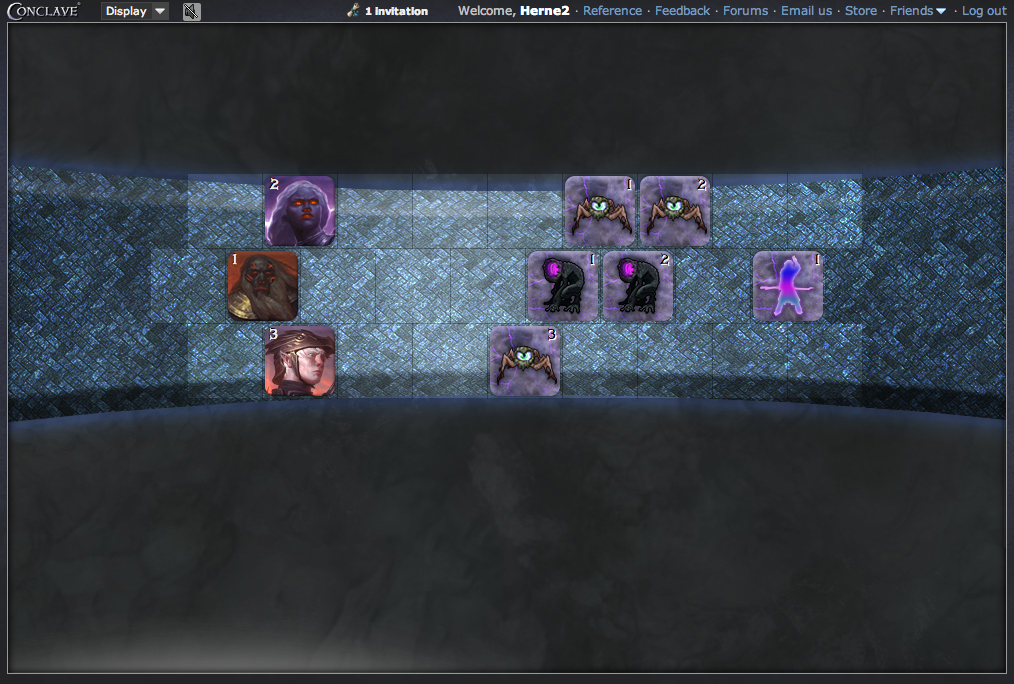
In Bastion, every combat takes place on a battlemap. This will feel familiar to most D&D players, especially in the age of miniatures play, as well as to the folks who enjoy turn-based computer RPGs.

There’s a great deal to be said about the how and what and why of creating battlemaps, and you can expect some posts along those lines soon. For now, though, how about some simple eye candy?

A battlemap set at the site of a recent shipwreck.

This is the wreck of the Seamaid, a ship from the north whose contents might contain certain revelations for the denizens of the Bastion. All that sea means a serious chokepoint at the middle of the thing, for good or bad.

All of the battlemaps are top-down, like this one. We are favoring a pretty realistic look to the graphics, balanced against the need for visual clarity: a map that’s too busy, filled with lots of contrasting bits, can make it hard to tell what’s going on, and we’d rather be overly simple than confusing. This map is among the busiest; it probably represents an outer limit of visual clutter.

Oh, heck, how about another?

A beach landing on a deserted (?) island.

This is from the same side quest, as the characters make their way to a landing on a dangerous island.

Want to see more of these? Let us know in the comments.

Powered by WordPress. Theme: Motion by 85ideas.